A Short Walk to the Three Springs
A Small Discovery in Luisenpark
A Short Walk to the Three Springs
A Small Discovery in Luisenpark
Today we take you on a walk to a special place in Erfurt. Almost everyone knows the Dreibrunnenbad swimming area at Luisenpark. But do you also know the three springs that gave it its name? No?
Then it is high time! We are curious to discover what awaits us as we explore the eventful history and the significance of these bubbling springs.
Life-Giving Water and Royal Recreation
The journey into the past of the three springs begins as we enter the park. We imagine how, as far back as the 15th century, when the marshy ground along the Gera river was first cultivated, people recognised the steady artesian springs as a vital source of life.
A key moment, as we read on an information board, was the year 1813, when a citizen of Erfurt combined the three springs into a single mineral fountain. We try to picture what the water might have tasted like back then – for each spring has its own salty character. It was certainly nothing delightful. A walking path, laid out in 1843, must have attracted many curious visitors even then.
When the city of Erfurt acquired the grounds in 1897, a new era began. We stroll along the sweeping paths that garden director Otto Linne had laid out, passing old groups of trees. Imagine how the park was officially opened in September 1900. A royal aura surrounds this place, for Queen Louise of Prussia visited Erfurt in 1803. The name Luisenpark still commemorates her today. We discover the old covered wooden bridge, relocated here in 1907, which now leads into the Dendrologischer Garten – a picturesque sight. The three springs were restored in 1992, and gave the Dreibrunnenbad swimming area, opened in 1902 on the opposite bank of the Gera, its fitting name.
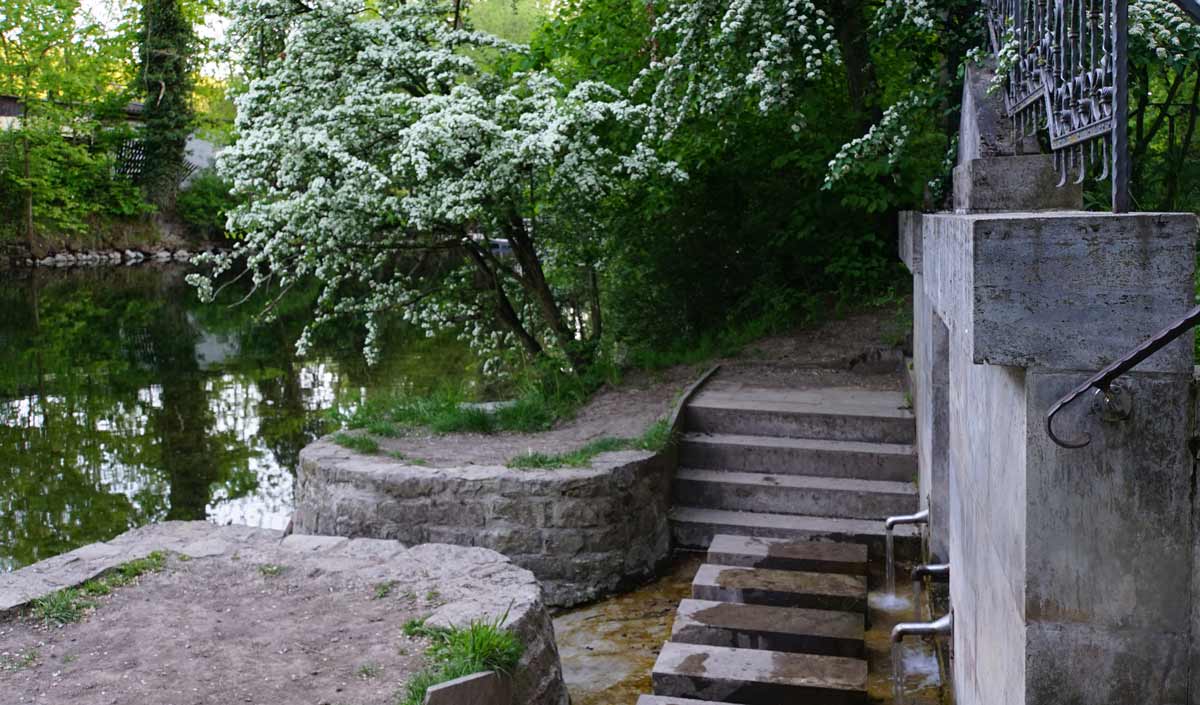
On the northern bank of the Gera, just before the Papierwehr weir, you will find the Three Springs
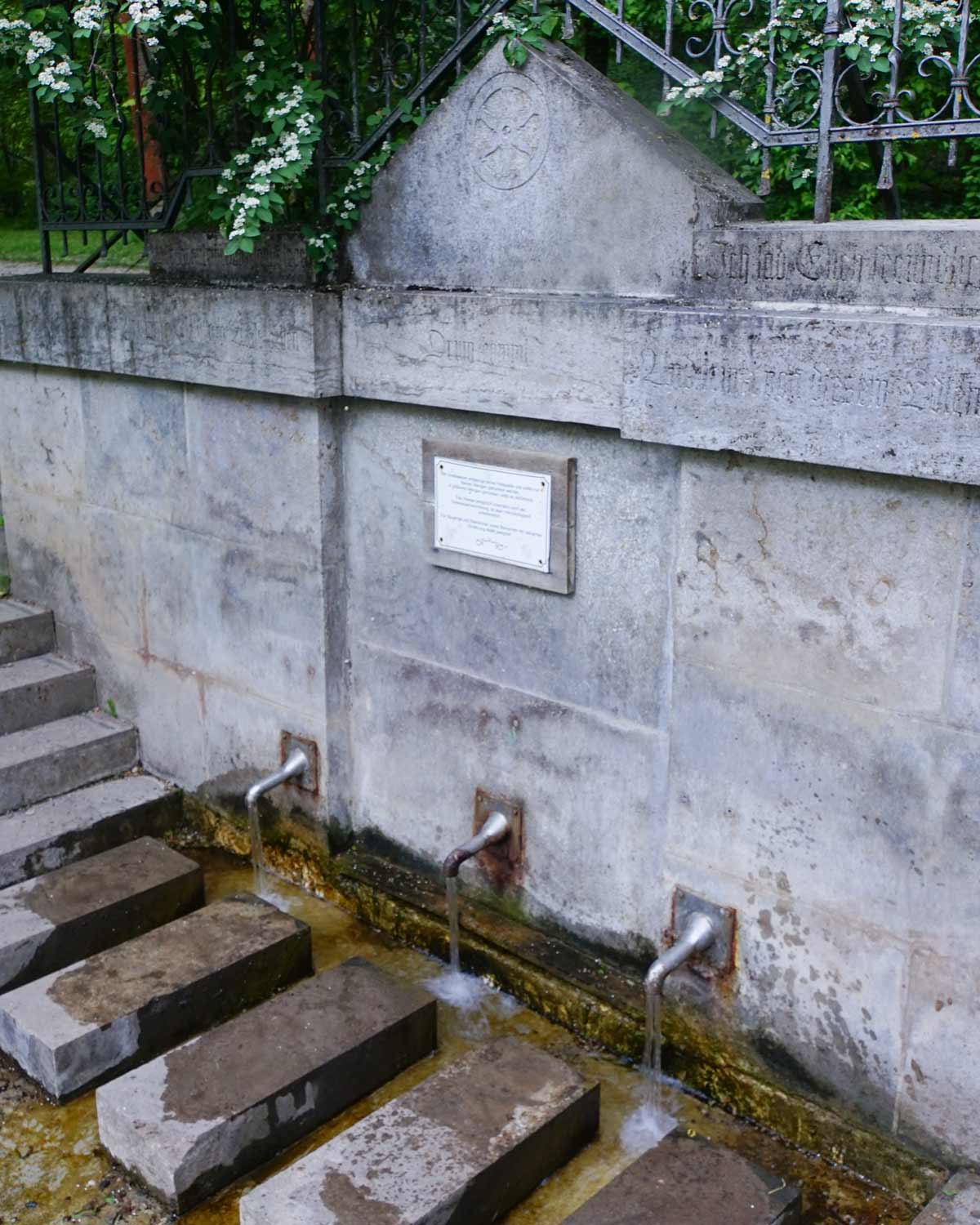
Healing Waters? Not Quite.
Not every spring with salty water qualifies as a healing spring. You can certainly taste the three differently-salted spring waters. But that is quite enough. They taste neither pleasant nor are they particularly beneficial to health. A sign explicitly points out that the water does not meet drinking water regulations.
For quenching your thirst, it is better to head to the nearby Dreibrunnenbad or the Espach-Café.
The Mystery of the Name: “Three Springs” or “Faithful Springs”?
The name “Dreienbrunnenpark” seems to refer to the three springs we are about to reach. Yet we learn that the botanist Friedrich Adolph Haage offered a different interpretation: “faithful springs” – sources that never run dry and have always reliably supplied Erfurt with water. A wonderful thought, emphasising the dependability of these waterways. The fact that each of the three present-day springs has its own mineral composition makes them all the more fascinating. And the name Luisenpark connects this place in a charming way to its royal history.
Legends and the True History of the Name
Myths and legends surrounding the springs are scarce, yet the place itself radiates a historical aura. We have read that older writings mention springs bearing names such as “Hangelicht”, the “Großen Brunnen” (also known as the Philosophers’ Spring) and the “Henkersbrunnen”. These were apparently located at the Steiger, south of the Gera, and were the true origin of the name for this area – not the springs we are about to see. The interpretation as “faithful springs” strikes us as the deeper, more symbolic history of the name. The enduring presence of the springs in the park stirs the imagination and invites us to reflect on a rich past.
The Three Springs Today: A Green Oasis
At last we reach them – the three springs – and despite the ongoing construction work at the Papierwehr weir, the Dreienbrunnenpark reveals its full charm as a beloved green oasis. People stroll along the paths, joggers train, children play and small groups enjoy their picnics. The park is a place of community. The annual Erfurt Duck Race, which starts here, is a joyful celebration. The historic wooden bridge we cross connects the park with the Dendrologischer Garten. The restored three springs are indeed a point of attraction, and their ever-flowing murmur recalls the legend of the “faithful springs”. This park is a living example of the harmonious connection between nature, history and community.
Conclusion
Our short walk to the three springs in Erfurt draws to a close. This place is now more than just a park to us; it is a living monument that connects urban history, nature and community in a remarkable way. The story, from the “faithful springs” to the park of today, speaks to the enduring significance of this place for Erfurt. As a place of recreation and encounter, the three springs preserve a precious heritage for all of us and remain a fascinating chapter in the chronicle of our city.
Discover the most beautiful sights in Erfurt now!